


Adding the Liberal Component of Democracy
The second principle of democracy in the series on V-Dem’s five principles of democracy is Liberal Democracy. The liberal principle of democracy emphasizes the importance of protecting individual and minority rights against a potential “tyranny of the majority” and state repression.
The concept of liberal democracy combines the electoral and liberal principles of democracy. It includes, but goes beyond, the existence of free and fair elections and freedom of expression, commonly understood as key components of electoral democracy, by taking into account the limits placed on government to prevent it from violating the rights of its citizens.
This liberal component of democracy is often achieved by a separation of powers into different branches of government by constitutionally protected civil liberties, strong rule of law, an independent judiciary, and effective checks and balances on the executive. Together, these factors limit the exercise of arbitrary power.
V-Dem's Measure of Liberal Democracy
V-Dem measures this liberal component via the Liberal component index, which is constructed from one stand-alone variable and three sub-indices. One of the most well-known V-Dem indices, the “Liberal Democracy Index” (LDI), builds on our Electoral Democracy Index (EDI) by combining it with the Liberal component index.
Included variables are, for example, to what degree there are transparent laws with predictable enforcement, or freedom from political killings - both indicators included in the Equality before the law and individual liberty index. Other examples are to what extent the executive respects the constitution (included in the Judicial constraints on the executive index), or how likely it is that a legislative body would investigate unconstitutional, illegal, or unethical activity by the executive in practice (included in the Legislative constraints on the executive index).
In total, the Liberal component index adds 20 more variables to the 45 in the Electoral democracy index.
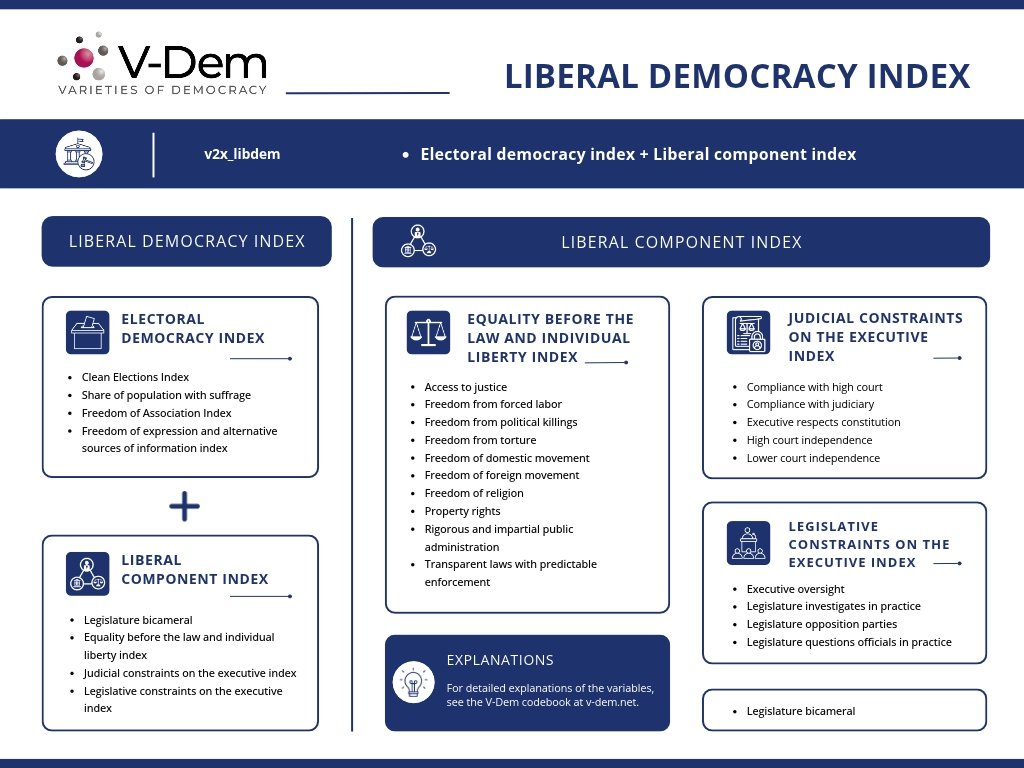
Overveiw of the sub-indices and variables included in the V-Dem Liberal Democracy Index.
You can explore all the individual variables that are part of the LDI and the included sub-indices with the V-Dem graphing tools. Use the drilldown-function to expand each index or sub-index to its variables by clicking on the lines in the graph. Or click on the LDI in the V-Dem Indices tab of any of the graphing tools to explore the multilevel tree of inputs going into the LDI.
You can also find tables of the specific indicators included in the V-Dem indices, and detailed descriptions of each indicator, in the V-Dem codebook.
How does the EDI affect scores on the Liberal Democracy Index?
As mentioned in the previous post on Electoral democracy, we would not call a regime without elections democratic. This is why the EDI is also an integral part of the Liberal democracy index.
One consequence of this is that a country’s score on the Liberal democracy index is to a certain extent dependent on its development on the Electoral democracy index. And since many of the election specific indicators in the EDI are only evaluated in election years, this limits how much a country’s score can change on the LDI in a year the country did not hold an election, or experienced another interruption in its electoral regime, such as via a military coup.
Considering that free and fair elections are such a vital part of democracy, it makes sense that even with a drastic change in some of the liberal components of the LDI, the effects on the overall LDI score might be dampened by the fact that many of the indicators in the EDI stay the same.
A recent example of this is the USA, which experienced a considerable fall in the LDI scores in 2025 compared to the election year 2024. But since there was no US election in 2025, the election specific indicators in the EDI stayed the same and therefore limited how much the US could fall on the LDI. However, as the US midterm elections are currently underway, the coming data update for 2026 will re-evaluate the election specific variables. This means that the next V-Dem data update (v.17) will give us a fuller picture of the state of democracy in the US than the v.16 update did. What that will mean for the US scores remains to be seen.
Read more
V-Dem Codebook https://v-dem.net/documents/70/codebook_v16.pdf
V-Dem’s Conceptions of Democracy and Their Consequences. Michael Coppedge. University of Gothenburg, Varieties of Democracy Institute: Working Paper No. 135. February 2023. https://v-dem.net/media/publications/wp_135.pdf
V-Dem Institute Democracy Report 2026: Unraveling The Democratic Era? (especially section 5: In Focus: Autocratization in the USA). Nord, Marina, David Altman, Tiago Fernandes, Ana Good God, and Staffan I. Lindberg. https://v-dem.net/documents/75/V-Dem_Institute_Democracy_Report_2026_lowres.pdf
Image information: A bronze statue of Lady Justice (Themis) with a blindfold and holding a scale, against a backdrop of the city Santiago in Chile. Photo by Ezequiel Octaviano/Pixabay.