

The Core Principle: Electoral Democracy
We continue the series on V-Dems five principles of democracy with the electoral principle. This principle embodies the core value of making rulers responsive to citizens through periodic elections.
While electoral democracy is widely agreed to consist of a combination of principles such as suffrage, free and fair elections, and some basic freedoms such as freedom of association and expression, it does not include more demanding features such as checks and balances or the rule of law.
Sometimes the electoral democracy principle is referred to as a thin or minimalistic definition of democracy, because free and fair elections are considered the bare minimum for the existence of any conception of democracy.
V-Dem’s Measure of Electoral Democracy
Electoral democracy exists when elections are free, fair, and recurring; elected officials wield political power de facto; suffrage is universal; political parties and candidates can form and compete freely; and there is a reasonably level playing field around elections in terms of freedoms of speech, media, and civil society.
V-Dem’s measure for electoral democracy is called the “Electoral Democracy Index", or EDI for short. The EDI is often referred to as V-Dem’s polyarchy index, as it builds on Dahl’s conceptualization of “polyarchy” as the real-world existence of the theoretical ideal of democracy.
The EDI captures not only the extent to which regimes hold clean, free and fair elections, but also their actual freedom of expression, the availability of alternative sources of information, freedom of association, as well as male and female suffrage, and how much control elected politicians have over government policy.
We would not call a regime without elections “democratic”. This is why the EDI is not just a stand-alone index, but also an integral part of the other four V-Dem democracy indices.
What Does the Electoral Democracy Index Measure
V-Dem’s Electoral Democracy index consists of five lower-level indices, which in turn are aggregated from a total of 45 indicators. It includes variables such as ‘Head of Government directly elected’ from the Elected officials index, ‘Opposition parties autonomy’ from the Freedom of association index, as well as ‘Election free and fair’ from the Clean elections index.
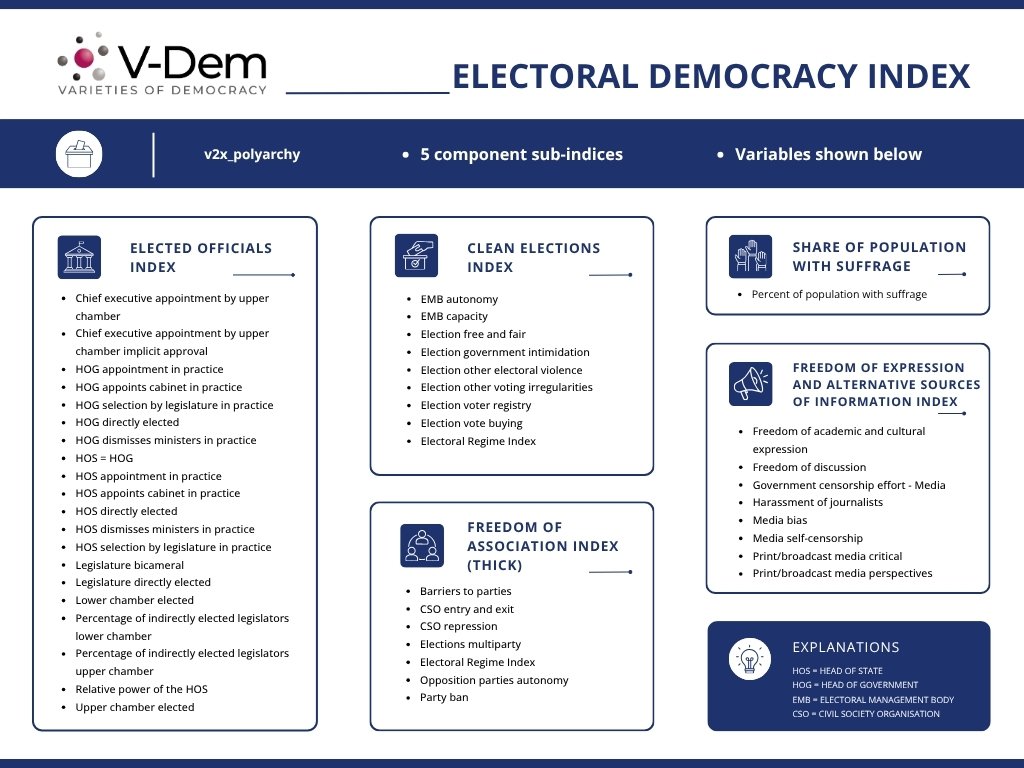
Overveiw of the sub-indices and variables included in the V-Dem Electoral Democracy Index.
You can explore all the individual variables that are part of the EDI with the V-Dem graphing tools. Use the drilldown-function to expand each index or sub-index to its variables by clicking on the lines in the graph. Explanations of each chosen variable are available underneath the graph. To explore the multilevel tree of inputs going into the EDI, you can also click on the EDI in the V-Dem Indices tab of any of the graphing tools.
Additionally, you can find tables of the specific indicators included in the V-Dem indices in the V-Dem codebook (Appendix A).
Some Aspects Are More Important
V-Dem’s understanding of electoral democracy implies that some aspects of democracy are more important than others. For example, we believe that the existence of competitive elections is more important than those elections being perfect, or society ideally fulfilling liberal values. Therefore, competitive elections should have a bigger impact on a country’s overall score on the EDI.
This is why the EDI, and some of our other indices, use a weighted average when we aggregate the variables. In the EDI, these weights are calculated through the Additive polyarchy index and the Multiplicative Polyarchy index.
Election Variables Evaluated in Election Years
Many of the variables in the EDI deal specifically with elections, such as the extent of election fraud in the last election. These indicators are only evaluated in election years. That means that the scores for 2025 on all election-specific indicators for a country that did not hold elections in 2025 are carried over from the last elections.
Since election-specific variables figure quite heavily in the EDI, - and to a lesser-but-still-important extent in V-Dem’s other democracy indices - there is a limit to how much a country’s score on these indices can change over the course of a year if it did not hold any elections or experience an interruption in its electoral regime, such as via a military coup.
Read more
Teorell, J., Coppedge, M., Lindberg, S. et al. Measuring Polyarchy Across the Globe, 1900–2017. St Comp Int Dev 54, 71–95 (2019). https://doi.org/10.1007/s12116-018-9268-z
Empirical Dimensions of Electoral Democracy. Matthew C. Wilson, Vanessa A. Boese. University of Gothenburg, Varieties of Democracy Institute: Working Paper No. 109. September 2020. wp_109_final.pdf
V-Dem’s Conceptions of Democracy and Their Consequences. Michael Coppedge. University of Gothenburg, Varieties of Democracy Institute: Working Paper No. 135. February 2023. https://v-dem.net/media/publications/wp_135.pdf
Dahl, R. A. (1971). Polyarchy: Participation and Opposition. New Haven, CT: Yale University Press.
V-Dem Codebook https://v-dem.net/documents/70/codebook_v16.pdf
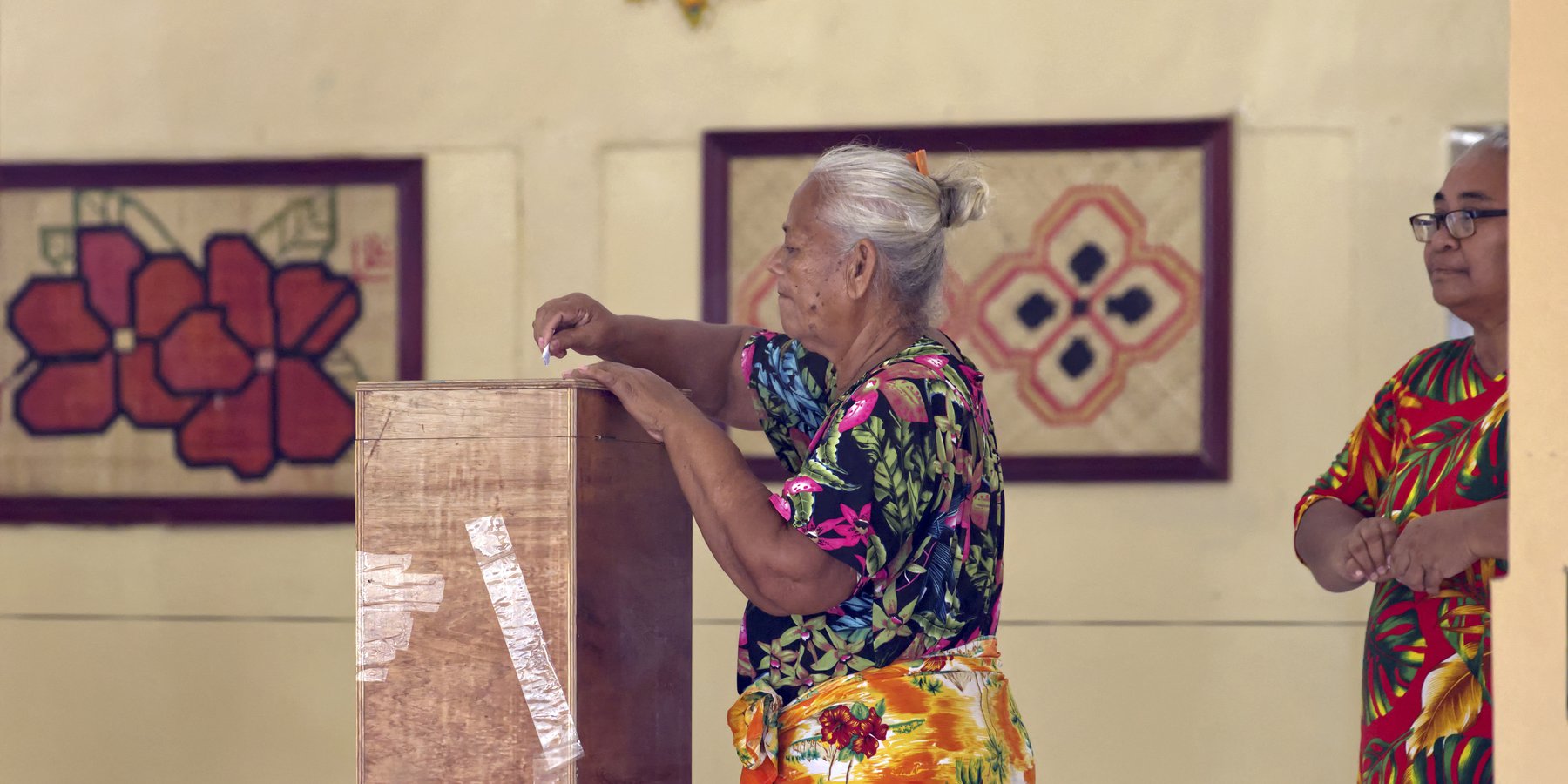
Image information: A woman placing her vote into a ballot box at a polling station on election day in Funafuti, the capital of Tuvalu, Jan 25, 2024. Photo by Sam Pedro/AFP via Getty Images.