The Portuguese translation of the Democracy Report 2026 is out! It includes a new article examining the origins and impact of the far-right in Portugal.
The original article puts the rise of the far-right in Portugal into perspective by looking at V-Dem data on political polarization, respect for counterarguments, and the mobilization for autocracy and democracy over the last 10 years.
Erosion of Democracy
The authors demonstrate that the rise of Chega, the main far-right party in Portugal, has coincided with an erosion of key dimensions of Portuguese democracy. Political polarization increased significantly, moving from near-zero levels in 2020, meaning that supporters of opposing camps frequently interacted amicably, to level 2 by 2024, where friendly and hostile interactions between political opponents became equally likely.
The deliberative dimension of democracy also declined. In 2019, Portugal ranked at level 4, meaning political elites almost always recognized and considered opposing arguments, even when rejecting them. By 2025, this had dropped to level 3, where elites tend to acknowledge opposing views but without clearly positive or negative engagement.
Mobilization for Autocracy
Additionally, the data shows a sharp increase in pro-autocratic mobilization since 2020. Portugal moved from very low levels of mass mobilization events supporting non-democratic forms of government and leaders who challenge democratic principles, or actions aimed at undermining the rule of law, free and fair elections, and freedom of the press in 2020, to levels approaching 2 by 2024, indicating numerous small-scale events.
The Positive Role of Civil Society
However, the authors conclude that Portuguese civil society remains an important safeguard against any potential democratic crisis. Patterns of protest in Portugal are closely linked to democratic institutions, and in recent years, mobilization in support of democracy has increased significantly. The data shows that pro-democratic mass mobilization moved from very low levels in 2019 to numerous small-scale events between 2024 and 2025, paralleling the rise in pro-autocratic mobilization.
According to the authors, Portuguese democracy demonstrates not only institutional resilience in the face of the far right but also benefits from a diverse and active civil society capable of resisting potential episodes of autocratization.
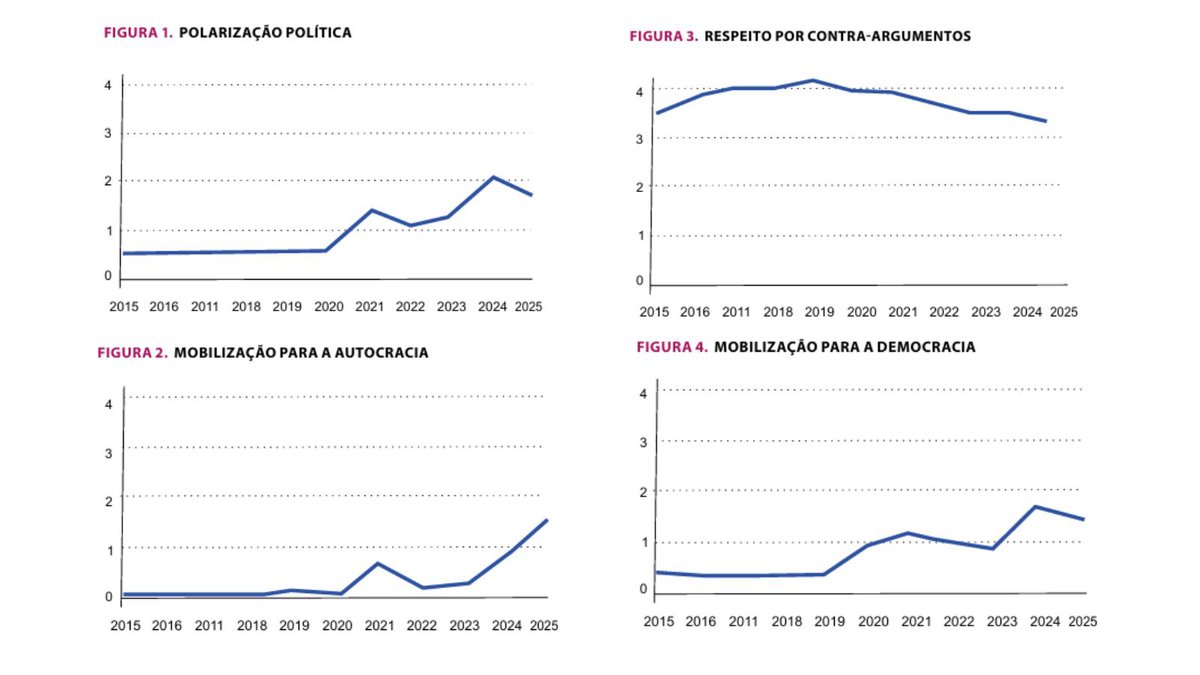
The development of political polarization, respect for counterarguments, mobilization for autocracy, and mobilization for democracy in Portugal 2015 - 2025.
Read More
Download “Relatório da Democracia 2026: Desvendar a Era Democrática?”.
- V-Dem Institute Democracy Report 2026 authors: Marina Nord, David Altman, Tiago Fernandes, Ana Good God, and Staffan I. Lindberg.
- Authors of the new section on Portugal: Tiago Fernandes, CEI-Iscte and Sara Pina, Universidade Lusófon.
The Portuguese translation of the 2026 V-Dem Institute Democracy Report is provided by the V-Dem Regional Center for Southern Europe and CEI-Iscte, University Institute of Lisbon.